Overview
What is Cypher?
Cypher is a declarative graph query language designed specifically for graph databases. It provides an intuitive and expressive way to query, manipulate, and manage graph data. Our implementation is based on the OpenCypher specification, which is an open standard for graph query languages.
Key Differences from SQL
While SQL is designed for relational databases with tables and rows, Cypher is optimized for graph databases with nodes, relationships, and properties:
- Structure: SQL uses tables and joins; Cypher uses nodes, relationships, and patterns
- Pattern Matching: SQL requires explicit joins; Cypher uses pattern matching syntax
- Traversal: SQL requires complex joins for multi-hop queries; Cypher naturally supports path traversal
- Readability: Cypher’s ASCII art syntax makes graph patterns visually intuitive
What Can You Do with Cypher in NeuG?
In NeuG, we refer to a Cypher query as a Statement. A Statement consists of multiple Clauses. For example, in the following query:
MATCH (p:person)
WHERE p.age = '29'
RETURN p.name as name;
The MATCH, WHERE, and RETURN components are called Clauses, which are the fundamental logical units for graph database operations.
Based on OpenCypher, we have defined a series of Statement syntax for managing NeuG’s graph database, including:
Schema Management (DDL)
NeuG primarily targets Schema-Strict graph data scenarios, where every piece of data must conform to predefined schema specifications. This is similar to traditional SQL; however, graph data involves more complex node and relationship structures that must also comply with predefined schema requirements.
For example, consider the following schema graph:
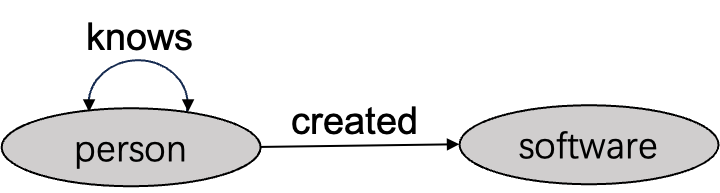
The above schema graph can be created by the following statements:
// Example schema definition
CREATE NODE TABLE person (
    name STRING,
    age INT32,
    PRIMARY KEY (name)
);

CREATE NODE TABLE software (
    name STRING,
    lang STRING,
    PRIMARY KEY (name)
);

CREATE REL TABLE knows (
    FROM person TO person,
    weight DOUBLE
);

CREATE REL TABLE created (
    FROM person TO software,
    weight DOUBLE
);
Schema-compliant query:
In the following query, the vertex label person and edge label (person-knows->person) both conform to the schema constraints defined above. The person node contains age and name properties, and the age property is of type INT32, which is comparable to the constant 18. Therefore, this query satisfies all schema constraints and is valid:
MATCH (p:person)-[:knows]->(f:person)
WHERE p.age > 18
RETURN p.name, f.name;
Non-schema-compliant query (would fail):
The edge label (person-follows-> person) specified in this query does not exist in the schema, making it invalid and resulting in a “Table follows does not exist” error.
MATCH (p:person)-[:follows]->(m:person)
RETURN p.name;
We define a set of syntax for creating schema graphs as shown above, which we call DDL (Data Definition Language). All subsequent data updating and query operations must conform to the schema specifications defined by the current DDL. We will introduce this in detail in the DDL section.
Data Query (DQL)
We also define a set of query syntax that can satisfy both Transactional Processing (TP) and Analytical Processing (AP) query requirements.
For example, you can query all triangle patterns in the graph database using the following query:
MATCH (a:person)-[:created]->(b:software),
      (c:person)-[:created]->(b:software),
      (a:person)-[:knows]->(c:person)
WHERE a.name < c.name
RETURN a.name, b.name, c.name;
We refer to each MATCH, WHERE, and RETURN as a Clause, which are the basic units of graph data operations. Here, the MATCH operation primarily matches all data that constitutes triangle patterns, WHERE further filters the pattern data to guarantee deduplication, and RETURN operations perform projection of names and output the final results. The MATCH operation mainly completes graph pattern matching, while WHERE/RETURN operations primarily perform relational operations similar to SQL. These clauses will be introduced in detail in DQL section.
To further ensure the legality of Clause operations on data, we have defined the data type boundaries that NeuG supports, as well as expression operations based on these data types. These will be introduced in detail in the Data Types and Expressions sections.
Data Management (DML)
In addition to DQL and DDL, NeuG also supports data update functionality, which we refer to as DML (Data Manipulation Language). DML operations can be performed through bulk loadings or incremental updates.
Bulk import example:
COPY person FROM "person.csv" (delim=',');
COPY knows FROM "knows.csv" (delim=',');
The above two Statements first bulk load node data with label person from person.csv, then bulk load edge data with label person-[knows]->person from knows.csv.
Incremental update example:
We also provide incremental write syntax for incrementally updating graph data.
Node creation example:
CREATE (p:person {name: 'Bob', age: 30});Relationship creation example:
MATCH (a:person {name: 'Bob'}), (b:person {name: 'marko'})
CREATE (a)-[:knows {weight: 3.0}]->(b);
Node deletion example:
MATCH (p:person {name: 'Bob'})
DELETE p;
We will introduce these DML operations in detail in the DML section.
Temporary Loading
NeuG provides temporary loading capabilities that allow users to query external data sources—such as CSV, JSON, and Parquet files—without importing the data into persistent graph storage. External data can be loaded on demand and queried directly, making this feature well suited for fast exploration, transformation, and ad-hoc analysis.
Depending on the query intent, NeuG supports two complementary loading models:
-
LOAD FROM Loads external data as temporary tables, enabling SQL-like operations such as projection, filtering, sorting, and aggregation.
-
LOAD AS Loads external data as temporary graphs, enabling graph pattern matching and traversal using
MATCHqueries.
Query Examples
You can use LOAD FROM to perform relational operations directly on external files.
For example, the following query loads a CSV file and returns the top 10 records ordered by age (ascending) and name (descending):
LOAD FROM "person.csv" (delim=',')
RETURN name, age
ORDER BY age ASC, name DESC
LIMIT 10;
For more complex graph-oriented analysis, external data can be loaded as a temporary graph and queried using graph patterns.
LOAD FROM "person.csv" (delim=',')
AS person;

LOAD FROM "knows.csv" (delim=',')
AS knows;

MATCH (p1:person)-[:knows*1..2]->(p2:person)
RETURN p1, p2;
This allows users to explore multi-hop relationships without materializing the graph into persistent storage.
Current Status
At present, NeuG fully supports loading external data as temporary tables via LOAD FROM.
You can refer to the Load From for detailed usage and supported operations.
Loading external data as temporary graphs via LOAD AS is currently under development, and detailed usage guidelines will be released in upcoming versions.
Extension
NeuG provides an Extension framework that enables dynamically adding new functionality without modifying the core engine code. Please refer to the Extensions section for more details.