We X-Rayed OpenClaw with a Graph Database — Here's the Technical Debt We Found
When a codebase grows to 21,000 functions connected by 35,000 call edges, code review alone isn’t enough. We ran OpenClaw through NeuG’s graph database and surfaced structural problems that traditional tools can’t see.
Why a Graph Perspective?
OpenClaw is a popular AI gateway project — 18,000+ commits, 6,000+ TypeScript files, and 21,000+ functions, with new versions shipping almost daily. In our previous post, we looked at OpenClaw from the user’s perspective and found that the heartbeat mechanism was consuming far more tokens than anyone expected.
This time, we go deeper. From a developer’s perspective: what structural debt has fast iteration quietly accumulated?
Traditional code review and static analysis tools catch a lot, but they struggle to answer structural questions:
- Which functions are “time bombs” — where a bug would cause maximum blast radius?
- Which code is dead weight, confusing new contributors who think it’s still active?
- Which module is the system’s structural hub — touch it, and half the codebase shakes?
The answers to these questions live in relationships, not in lines of code.
The Approach: Turn the Codebase into a Graph
We built a code knowledge graph using NeuG (graph database) and zvec (vector database):
- Nodes: functions, classes, modules, files
- Edges: call relationships, import dependencies, commit history
Here’s what the graph looks like at scale:
| Type | Count |
|---|---|
| Source files | 6,062 |
| Functions | 21,057 |
| Call edges | 35,761 |
| Import edges | 25,883 |
| Classes | 233 |
| Modules | 318 |
21,000 functions connected by 35,000 call edges. Once the graph is built, hard structural questions become Cypher queries.
The full analysis pipeline is packaged as CodeGraph Skill — open source and fully reproducible.
Finding 1: High-Risk Functions
Defining Risk Score
We define a risk score for each function to quantify its potential blast radius:
Risk Score = fan_in × fan_out
- fan-in: how many functions call it (dependency pressure)
- fan-out: how many functions it calls (dependency complexity)
The product represents the blast radius — how much of the system breaks if this function has a bug.
Detecting fan-out is straightforward; most IDE tools can do it. But fan-in requires a full-codebase scan — exactly where a graph database shines. This is one of the built-in capabilities of our CodeGraph Skill: it ships with a hotspots() method that handles the full-graph traversal for you, so finding the highest-risk functions across the entire codebase is a single call:
functions = cs.hotspots(topk=30)
Top 5 by risk score:
| Function | File | fan-in | fan-out | Risk Score |
|---|---|---|---|---|
| startGatewayServer | src/gateway/server.impl.ts | 10 | 103 | 1030 |
| createConfigIO | src/config/io.ts | 18 | 56 | 1008 |
| runEmbeddedPiAgent | src/agents/pi-embedded-runner/run.ts | 14 | 67 | 938 |
| loadOpenClawPlugins | src/plugins/loader.ts | 20 | 36 | 720 |
| runCronIsolatedAgentTurn | src/cron/isolated-agent/run.ts | 11 | 60 | 660 |
These functions sit at the core of critical execution paths. startGatewayServer bootstraps the entire service; createConfigIO generates all configuration; runEmbeddedPiAgent orchestrates embedded Pi Agent execution.
Here’s an interesting observation about createConfigIO: configuration parsing rarely gets prioritized for test coverage — it “seems safe.” But with 18 callers and 56 outgoing calls, by structural risk metrics it’s one of the most dangerous functions in the entire codebase.
Filtering for the Real High-Risk Core
We wrote a custom Cypher query to filter out low-level utility functions (high fan-in, low fan-out) and focus on functions that are simultaneously heavily depended upon and highly complex:
MATCH (f:Function)-[:CALLS]->(g:Function)
WITH f, COUNT(DISTINCT g) as fan_out
MATCH (f)<-[:CALLS]-(h:Function)
WITH f, fan_out, COUNT(DISTINCT h) as fan_in
WHERE fan_in > 10 AND fan_out > 10
RETURN f.name, fan_in, fan_out
LIMIT 100
The result was surprising: only 17 functions in the entire codebase meet both criteria. Every one of them is a critical, high-risk node:
| Function | File | fan-in | fan-out | Risk Score |
|---|---|---|---|---|
| startGatewayServer | src/gateway/server.impl.ts | 10 | 103 | 1030 |
| createConfigIO | src/config/io.ts | 18 | 56 | 1008 |
| runEmbeddedPiAgent | src/agents/pi-embedded-runner/run.ts | 14 | 67 | 938 |
| loadOpenClawPlugins | src/plugins/loader.ts | 20 | 36 | 720 |
| runCronIsolatedAgentTurn | src/cron/isolated-agent/run.ts | 11 | 60 | 660 |
| getReplyFromConfig | src/auto-reply/reply/get-reply.ts | 20 | 24 | 480 |
| runMessageAction | src/infra/outbound/message-action-runner.ts | 21 | 22 | 462 |
| loadPluginManifestRegistry | src/plugins/manifest-registry.ts | 22 | 16 | 352 |
| createOpenClawTools | src/agents/openclaw-tools.ts | 10 | 24 | 240 |
| fetchWithSsrFGuard | src/infra/net/fetch-guard.ts | 24 | 10 | 240 |
| resolveCommandSecretRefsViaGateway | src/cli/command-secret-gateway.ts | 15 | 14 | 210 |
| fetchRemoteMedia | src/media/fetch.ts | 18 | 11 | 198 |
| loadModelCatalog | src/agents/model-catalog.ts | 18 | 11 | 198 |
| resolveApiKeyForProvider | src/agents/model-auth.ts | 13 | 15 | 195 |
| start | src/gateway/client.ts | 12 | 13 | 156 |
| resolveAuthProfileOrder | src/agents/auth-profiles/order.ts | 11 | 11 | 121 |
| createClackPrompter | src/wizard/clack-prompter.ts | 10 | 11 | 110 |
These 17 functions are the structural pressure points of the system. Any change to them deserves extra scrutiny.
Finding Zombie Functions
We plotted the fan-in distribution across all functions as a histogram. NeuG’s Python SDK makes this straightforward — query results flow directly into pandas or matplotlib. The distribution reveals that most functions have fan-in and fan-out values below 2, meaning OpenClaw’s code is largely linear: most functions sit in a simple “one-in, one-out” position in the call chain.
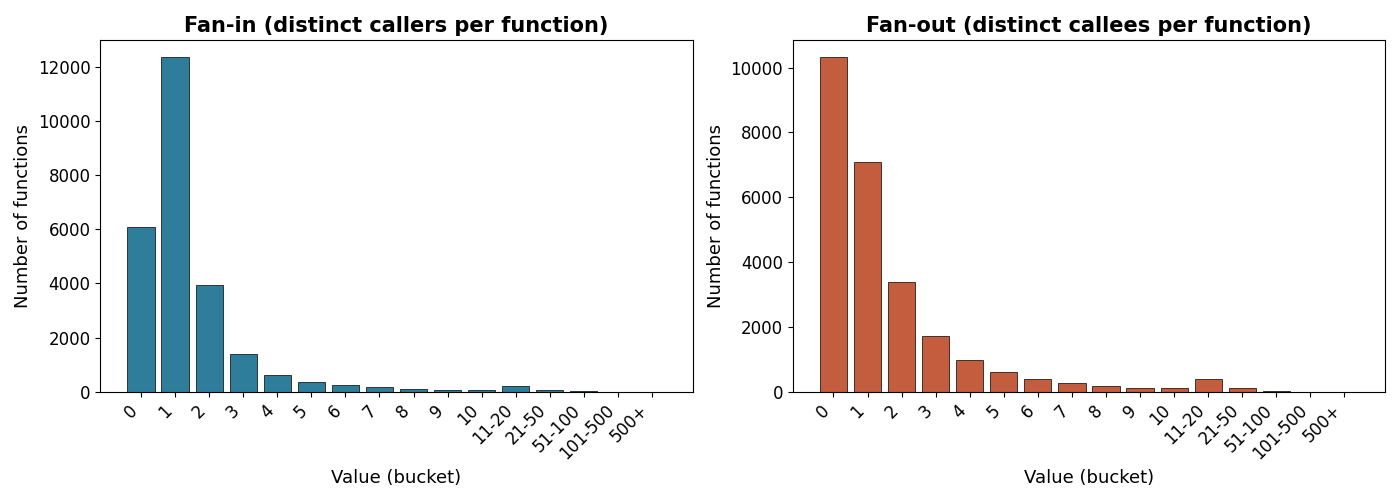
What stands out: over 20% of all functions have fan-in = 0 — they are never called by anything. After filtering out legitimate entry points and framework hooks, more than 2,000 functions remain that are true zombie code.
Here’s a concrete example. assertPublicHostname in src/infra/net/ssrf.ts has zero callers in the current codebase. A git bisect reveals:
- Commit
5bd550: the function is introduced and actively used - Commit
b62355: its logic is migrated toresolvePinnedHostname - The old function is never deleted — likely out of caution — and silently becomes a zombie
The real harm isn’t the wasted lines. It’s what happens next: a new contributor finds the function, assumes it’s still relevant, builds something on top of it, and then spends hours debugging a dead code path.
In a project with OpenClaw’s pace of change, a 20% zombie function rate is a significant cognitive tax on everyone who reads the code.
Finding 2: The Over-Coupled Module
We analyzed the 20 most recent bug reports. Of 57 root-cause function candidates, 24 — 42% — pointed to src/agents.
To understand why, we ran a Cypher query to inspect agents’ call relationships with the rest of the system:
MATCH (m1:Module {name: 'agents'})<-[:BELONGS_TO]-(f1:File)-[:DEFINES_FUNC]->(func1:Function)
MATCH (func1)-[:CALLS]->(func2:Function)<-[:DEFINES_FUNC]-(f2:File)-[:BELONGS_TO]->(m2:Module)
WHERE m2.name <> 'agents'
RETURN m2.name, count(*) as call_count
ORDER BY call_count DESC
LIMIT 10
The numbers below show bidirectional call counts between modules (a→b = calls from module a into module b):
agents <-> reply              a→b=19    b→a=117
agents <-> infra              a→b=108   b→a=15
agents <-> pi-embedded-runner a→b=19    b→a=88
agents <-> tools              a→b=38    b→a=55
agents <-> plugins            a→b=45    b→a=40
agents <-> gateway            a→b=9     b→a=60
agents <-> src                a→b=35    b→a=31
agents <-> models             a→b=1     b→a=63
agents <-> sessions           a→b=46    b→a=5
agents <-> auth-profiles      a→b=24    b→a=12
In total, 30+ modules have bidirectional dependencies with agents. The reply module calls into agents 117 times; pi-embedded-runner calls it 88 times; models calls it 63 times. The vast majority of the system’s business logic flows through this one module.
We visualized the reply->agents call relationships using neug-ui:
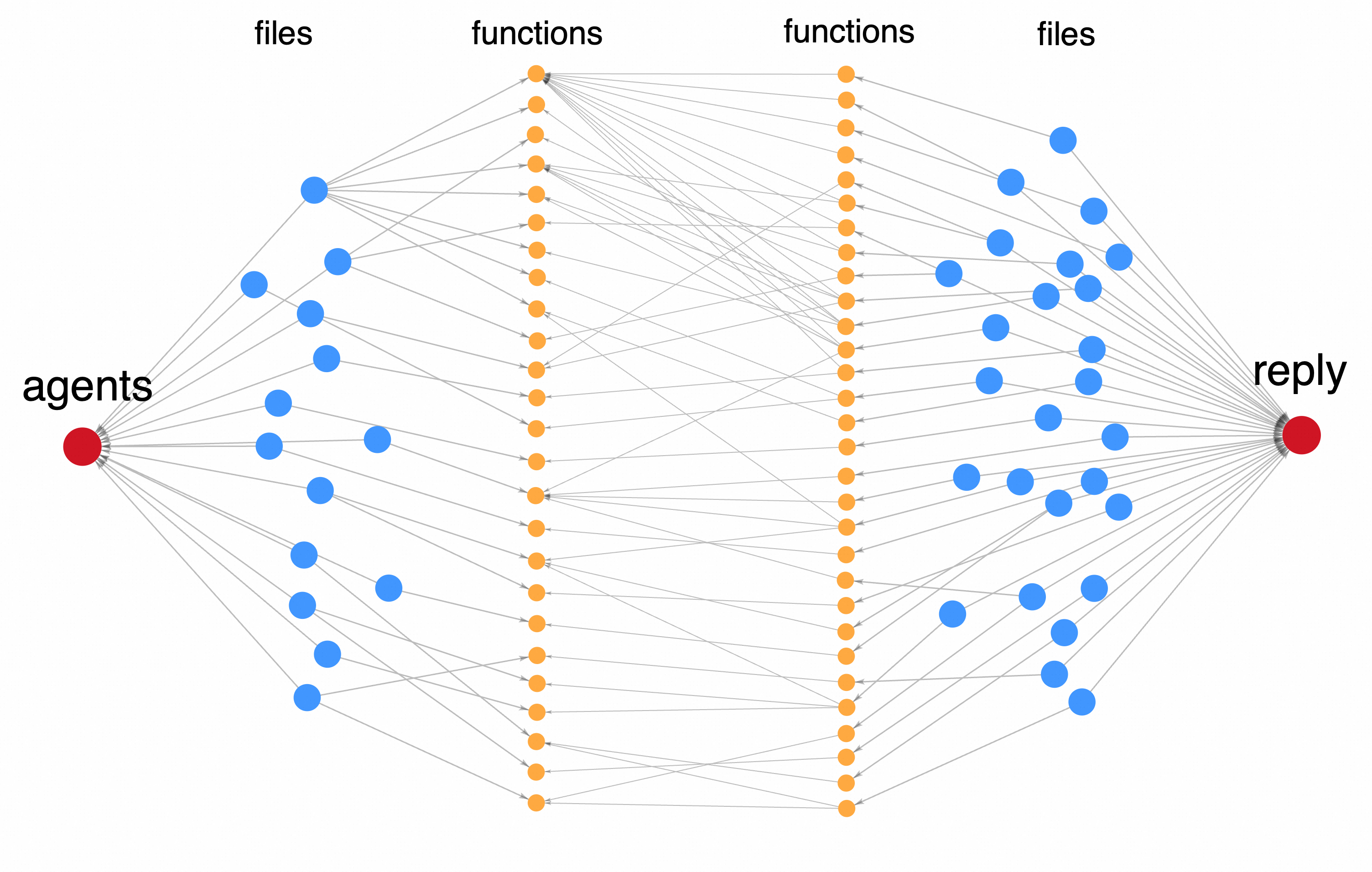
agents is the structural hub of the system. A single-line change there can ripple across half the codebase. The fact that 42% of bugs trace back to this module isn’t bad luck — it’s an architectural consequence.
What Graph Analysis Reveals That Other Tools Don’t
Code review catches function-level issues. Static analysis handles syntax and import-level concerns. Graph analysis fills the gap between them — cross-file, cross-module structural problems:
Traditional tools can tell you:
- Which line has a syntax error
- Which function has high cyclomatic complexity
NeuG can tell you:
- How many functions are affected by a single change
- Which code is dead but still confusing contributors
- Which module is the structural load-bearing wall of the system
When a codebase outgrows what human reviewers can hold in their heads, structural problems can only be found through structural queries.
Three Recommendations for OpenClaw
Based on this analysis, the three highest-leverage improvements:
- Decouple
src/agents: With 30+ modules in bidirectional dependency, start by defining clear interface boundaries betweenagentsand its heaviest callers (reply,pi-embedded-runner,models). Even partial decoupling would significantly reduce blast radius. - Prioritize test coverage for high-risk functions: Functions like
createConfigIOandstartGatewayServerare structurally critical but likely undertested. A bug there propagates everywhere. Cover them first. - Clean up zombie functions: 2,000+ dead functions are actively misleading contributors. Running a graph-based dead code analysis and removing confirmed zombies is a high-ROI cleanup with low risk.
Analysis powered by NeuG graph database and CodeScope code analysis engine. Full index completed in approximately 4 minutes.